Home / Recruitment / Customer story
PRA's story

How PRA uses Cognaire Respond to find better candidates faster

Professional Recruitment Australia (PRA) is using Cognaire Respond to move beyond traditional Boolean search, identify top candidates faster, and give consultants more time for the human side of recruitment.

Genuine AI value Beyond Boolean search Faster prioritisation More consistent output
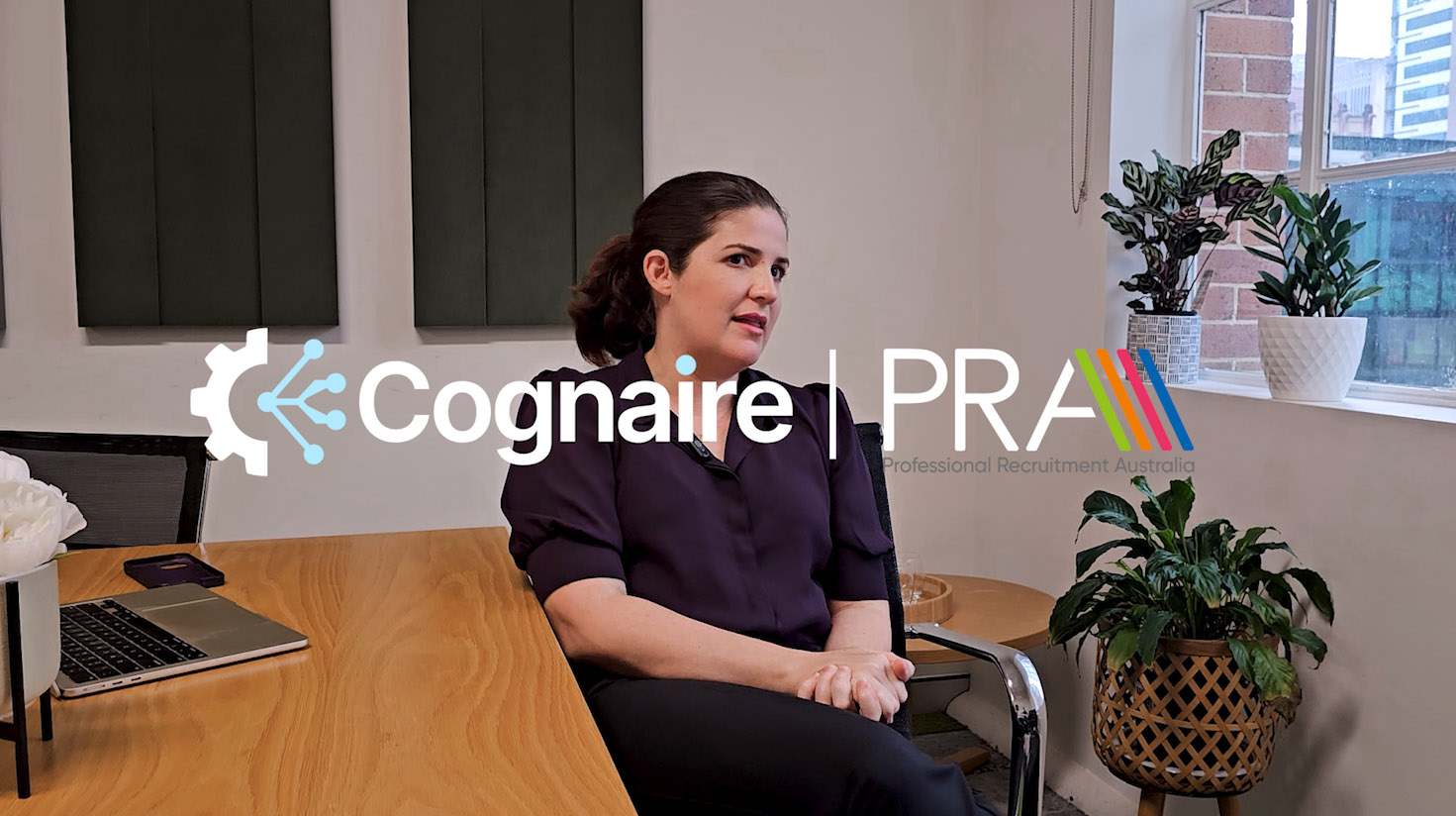
Carrah Jordan, CEO of PRA

PRA × Cognaire Respond — customer story

~ 3 min
"Cognaire is the first product that I have come across in the recruitment ecosystem that's actually delivering genuine AI value."
Carrah Jordan
Carrah Jordan
CEO, Professional Recruitment Australia
Customer snapshot

PRA is an IT recruitment company operating on the eastern seaboard of Australia, across Brisbane, Sydney and Melbourne. The team works in a market where speed, candidate quality and consultant judgement all matter.

Industry
Recruitment & staffing
Specialism
IT recruitment
Locations
Brisbane · Sydney · Melbourne
Interviewee
Carrah Jordan, CEO
Use case
Candidate matching, shortlist prioritisation & consultant productivity
Product
Cognaire Respond for Recruiters
The market problem

Recruitment software is full of AI claims. PRA wanted value it could actually use.

Recruitment leaders are shown AI features everywhere. The hard question is whether those features change the way consultants work — or simply add another layer of noise. For PRA, the opportunity was not to replace recruiters. It was to use AI where it improves the real operating workflow: interpreting job briefs, finding stronger-fit candidates, and reducing manual review without lowering quality.

"There are lots of products in recruitment at the moment that are claiming to do AI — and the reality is that they're not."

Carrah Jordan · CEO, PRA
Match Search · Senior Platform Engineer Semantic
Priya ShahCV says "infrastructure engineer" — no keyword match
93
Mateo ÁlvarezEquivalent cloud & container experience
88
Anna LindenAdjacent SRE background, different wording
81
Ranked by meaning, not keywords — strong fits surface even when the CV uses different words.
Beyond Boolean search

Finding strong candidates when the words don't match perfectly

Traditional recruitment search depends heavily on keywords and Boolean logic — so good candidates get missed when their CV doesn't use the exact terminology in the brief. Respond helps PRA search by meaning and context, surfacing candidates whose experience fits the role even when it's described differently.

Traditional Boolean search

Exact keywords. Rigid terms.

  • Matches only the precise words in the search string
  • Less-experienced consultants struggle most — they don't always know the right technical terms to search for
  • Strong people are missed for an imperfectly written CV
Cognaire Respond

Meaning and context. Role fit.

  • Reads the brief and ranks candidates by genuine relevance
  • Recognises equivalent skills, tools and experience
  • Surfaces fit even when the CV uses different language

"You can be a fabulous software engineer or a fabulous project manager and have a terrible resume because you're not actually good at that."

Carrah Jordan · CEO, PRA
Before & after

Best-fit candidates rise to the top sooner

Before Respond, every application was reviewed by hand. Now PRA searches across its existing database and live applicants at once, ranks them against the role, and lets consultants reach the strongest matches first — a better starting point for the human work that follows.

Before Respond — manual review first
  1. Job posted to a job board
  2. Applications land in the CRM
  3. Every application reviewed by handConsultants rule candidates in or out on skills, location and other criteria
  4. Calls, interviews, client submission
With Respond — prioritised first
  1. Search database + live applicants togetherExisting talent pool and people applying in real time, in one search
  2. Respond ranks candidates against the role
  3. Strongest matches surfaced in seconds
  4. Call top-ranked candidates immediately

"If you'd called those people late this afternoon, maybe they're not available tomorrow morning anymore. Being able to move fast on the best candidates is what makes the difference."

Carrah Jordan · CEO, PRA
Speed to candidate

"It allows us to have a first mover advantage"when contacting candidates for a new role

Carrah Jordan · CEO, PRA

Carrah Jordan with a PRA consultant
Human-centred AI

More time for the work recruiters actually value

PRA's story is not about removing recruiters from the process. It's about reducing the manual load around candidate review and prioritisation, so consultants can spend more time with candidates and clients — where they build trust, uncover nuance and create real value.

"They get more time to talk to their candidates, more time to talk to their clients, more time to work on the human relationship aspect of recruitment."

Carrah Jordan · CEO, PRA
Listen to this answer
—:—
Consistency across the team

Raising the floor — and validating the best consultants

One of the strongest outcomes for PRA is consistency. Respond helps less experienced consultants produce higher-quality output, while validating the judgement of top performers. Candidate delivery quality no longer varies wildly depending on who is running the search.

"Cognaire Respond has levelled the playing field for my consultants."

"It has lifted up those who are not as experienced to be of a higher quality in their output, and it has validated the decisions of our top consultants."

"To have that consistency across our business is invaluable."

Carrah Jordan
Carrah Jordan
CEO, PRA
How this maps to Respond for Recruiters

Built for the workflow around the ATS

Respond is designed for recruitment and staffing teams that submit candidates to external clients — better candidate discovery, faster prioritisation and more consistent output, without asking consultants to abandon the systems they already use.

Format candidate profiles

Turn incoming CVs into branded, structured profiles and searchable candidate records.

Match by meaning & context

Rank candidates against the job brief without relying only on exact keywords or Boolean search.

Assess candidate fit

Compare strengths, gaps, readiness and fit before candidates are submitted.

Submit with confidence

Prepare client-ready packs with formatted CVs, summaries and optional review steps.

How a search runs, end to end

Job brief + candidate pool
Semantic match search
Strongest-fit candidates prioritised
Consultants reach the right people faster
PRA by the numbers

The difference Respond is making at PRA

99%

Reduction in time to identify best-fit applicants. From ~2 hours of manual review to ~30 seconds with Cognaire shortlisting.

60×

Faster CV formatting. Previously sent offshore and returned 1–5 hours later — now produced in around 2 minutes.

50k

Candidate profiles semantically matched against each job brief — ranked by genuine fit, not keywords.

Audio Q&A

Full Q&A with Carrah

A sit-down interview with Carrah Jordan, CEO of PRA. Listen to her answer each question in her own words, or read the transcript below.

Q1

Before Cognaire Respond, which parts of the candidate delivery workflow were most manual or time-consuming?

Listen to Carrah's answer
—:—
Read transcript

Going through resumes or applications that have come through the system via SEEK or via LinkedIn has always been the most time-consuming piece.

A lot of people like to think that an ATS filters them in or out historically, but the truth is that's not really a thing. Yes, there are ways that you can run a Boolean search on a traditional ATS where that would happen, but the reality is, in the workflow in our business, if someone applied for a job, we were looking at their application manually — even if they were in a different country, even if they didn't have any of the skills required for the job. Someone would still lay eyes on that application in order to mark it off or roll it into the shortlisted pool.

The way that our workflow was set up, people would have to look at every resume with a human eye to be sure that they had genuinely looked at every possible option for someone who was directly applying for one of our jobs at the time.

The highest-effort roles are helpdesk, because every person and their dog will apply, irrespective of capability — you might have up to 300 or 400 applications for a helpdesk role. For project managers, if the role is relatively generic, we would also have lots and lots of applications, and ultimately a lot of them wouldn't be the right fit, but if someone had at some point in their life held a project manager title, they're inclined to throw their hat in the ring.

Q2

Before Cognaire Respond, how did CV formatting work? Who handled it, and how long could it take?

Listen to Carrah's answer
—:—
Read transcript

Before we started using Cognaire, we used to send our resumes to a company in the Philippines and a team of people there would manually format each of our CVs, put them onto our company-branded template, and then send those back to us by email.

That could take anywhere from one hour to five hours depending on the day. And to be honest with you, because it was a human handling it, there was actually a reasonable amount of human error that still happened through that process. Previously it was a much longer process, and not actually as consistent or high quality in its output.

Q3

Before Cognaire Respond, when a client sent a job brief, what slowed the path from brief to shortlist?

Listen to Carrah's answer
—:—
Read transcript

Candidate sourcing absolutely takes up the majority of the time that we spend as recruiters. It's why people use recruiters — because having to trawl through a pile of applications or a database with 500,000 resumes in it, and having to determine who is the right fit for a given role, takes a lot of time. And if it was quick and easy, people wouldn't need recruiters. But the reality is it's not quick and easy. That's what you pay for.

Q4

What made you interested in Cognaire Respond?

Listen to Carrah's answer
—:—
Read transcript

Seeing the ability of AI to not just Boolean-search a resume, but actually semantically search a CV and be able to look for people's intent — implied experience that wasn't necessarily written down through exact wording, but was written down in a way that could be surmised by a human brain and therefore could be surmised by AI — was really exciting.

The reality is, writing a resume is a skill unto itself. You can be a fabulous software engineer or a fabulous project manager and have a terrible resume because you're not actually good at that. Cognaire as a concept was very, very appealing — to be able to rule those people in where they might not otherwise have been ruled in, because they weren't using the exact keywords we'd been given, or even the exact keywords we were used to searching for, because we're creatures of habit.

Q5

Which parts of Respond are most useful to PRA today?

Listen to Carrah's answer
—:—
Read transcript

All of it.

The CV formatting is really helpful because we use it all day, every day. But ultimately all of our consultants are using the CV semantic search function for every job they're working on.

For consultants who have a higher level of technical capability, it allows them to get a really well-crafted highlight-reel summary of why a candidate is an excellent fit for a job, and what red flags they might have that we haven't thought about — because we can get so caught up in the excitement of finding the right candidate that we stop looking at the red flags.

For consultants who aren't necessarily as technical, it's a wonderful QA measure. They can run CVs they think are good for a role through the Cognaire system and it can sanity-check and validate that they are on the right track, that there's nothing substantial they're missing or haven't considered.

Q6

Has Respond changed speed, consistency, quality, consultant capacity, or client presentation?

Listen to Carrah's answer
—:—
Read transcript

Absolutely.

The CV formatting function alone uses AI to write a candidate's summary based on their resume, so that even as a base foundation level, once our consultants meet and interview a candidate, they can add to and extrapolate from that pre-written summary. I believe that is providing a massive amount of consistency that didn't exist before.

Additionally, the summary that Cognaire Respond generates through its CV search and analysis — being able to take those notes and use them for client presentation — is a cut above anything that I think we were consistently doing across the board. We probably had a couple of our more senior staff members who could do that level of analysis and write that kind of summary for our clients that well. But the fact that we can now have that quality consistently across the whole business is second to none.

Q7

How have key metrics improved with Cognaire Respond?

Listen to Carrah's answer
—:—
Read transcript

Historically, when we would post a job ad and have applications come in, we would probably spend up to two hours going through applications manually — working out who should be ruled in and given a call, and who should be ruled out. Then from there we would contact the relevant people.

Because of Cognaire and its ability to shortlist and highlight the best possible applicants to the top of the list in around 30 seconds, we're now calling the best people for the role faster. That means we can submit the best people for the role faster, which means we can give people job offers faster. There has absolutely been an uplift in the amount of time spent upfront on filtering, from our old way versus what we're doing now.

The way it works in practice: we run Cognaire first and call the top five people. We still go through the rest of the process — we still look at everyone — but by getting in quickly and locking in probably the best candidates straight away, it just collapses the timeline. If you'd called those people late this afternoon, maybe they're not available tomorrow morning anymore — they're only available tomorrow afternoon or the next day. So it just pushes out. Being able to move fast on the best candidates is what makes the difference.

Q8

What should other recruitment agencies understand about AI and Respond?

Listen to Carrah's answer
—:—
Read transcript

If you are in recruitment and you aren't opening your eyes to the fact that AI is disrupting our industry, it's probably something you need to be seriously considering — because that is just the reality of what is happening. Exactly what that's going to look like in the future I don't profess to know, but I certainly know that the kind of function and service that Cognaire Respond is offering our business is absolutely a step in the right direction of making sure that we harness the opportunities that AI presents and make the best of them — to get the best outcomes for our candidates and our clients. If you're not thinking about any of these things, you're probably going to be left behind.

Accessibility

Video transcript

Prefer to read or scan? The key moments from Carrah's story, in her words.

Read the transcript highlights
Carrah

"There are lots of products in recruitment at the moment that are claiming to do AI — and the reality is that they're not."

Carrah

"Cognaire is the first product that I have come across in the recruitment ecosystem that's actually delivering genuine AI value."

Carrah

"When Cognaire Respond came along, I felt excited about the opportunity to use the semantic search function that AI provides, which would move us beyond the traditional Boolean search."

Carrah

"Seeing the opportunity to not have candidates miss out because they haven't written a perfect resume with the perfect keywords…"

Carrah

"Applications would come into our CRM. We would manually look through every single application that came into our CRM."

Carrah

"With Cognaire Respond, we are able to take a list of candidates — both from our existing database and people applying to a role in real time — and run a search that pushes the best candidates or the best match for a given role. It allows us to have a first mover advantage."

Carrah

"They get more time to talk to their candidates, more time to talk to their clients, more time to work on the human relationship aspect of recruitment."

Carrah

"Cognaire Respond has levelled the playing field for my consultants. It has lifted up those who are not as experienced to be of a higher quality in their output, and it has validated the decisions of our top consultants. To have that consistency across our business is invaluable."

See Respond on your own job brief and CVs

Bring a redacted job brief and a handful of CVs. We'll show how Respond formats candidate profiles, searches by meaning and context, and helps your team move from brief to stronger shortlist faster.